Building a watering and aftercare plan for newly planted trees
Organise observation, responsibilities and records for new landscape trees. Build a site-specific aftercare plan instead of relying on one watering number.
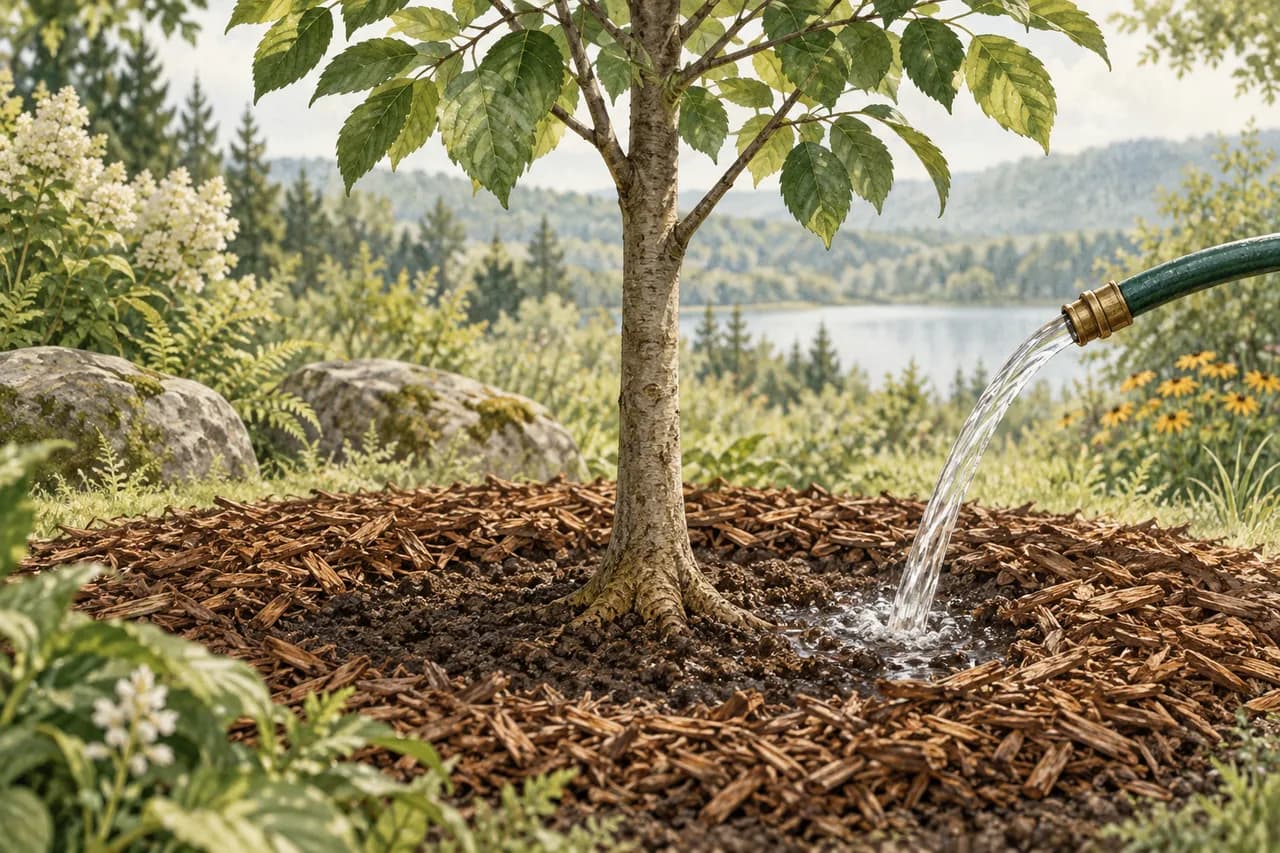
Buyers often ask how many litres of water every newly planted tree should receive. A workable project aftercare plan needs more than one number applied to all plants. Species, root systems, soil, weather and installation conditions belong in the assessment. This guide focuses on organising the observations and responsibilities that help a maintenance team manage that process.
Avoid a universal watering rule
University of Maryland Extension explains that watering frequency depends on plant type, soil texture, whether a plant is new or established and local weather. Do not copy a litres-per-day table from another project without assessing those differences.
Obtain a suitable starting plan from the project's horticultural adviser and review it against real observations. Having an irrigation system does not prove that each root zone receives the same amount of water. Include checks of the actual delivery and operation in the maintenance tasks.
Create groups that can be monitored
Dividing the schedule only into deciduous trees and conifers may not be detailed enough for care planning. Consider species, planting date, root presentation and position on the site. A sunny entrance and a sheltered courtyard should not automatically share one observation record.
Give each group a reference on the layout. When everyone uses the same location code instead of “the tree in the back row”, observations and actions are easier to connect over time.
Keep a simple observation record
- Date, observer and plant group.
- Brief weather and watering notes.
- Observed soil and root-zone conditions.
- Changes in foliage, shoots, stems or ties.
- Action taken and next review date.
- Any advice requested and the response received.
The record is a way to show change, not a diagnostic tool on its own. Yellowing or wilting does not prove a single cause. Rather than automatically increasing watering, review conditions and the application history with the relevant adviser when symptoms appear.
Discuss care responsibilities during procurement
If delivery, planting and maintenance involve different teams, record when responsibility passes between them. Do not assume the plant quotation includes installation and ongoing care. Where a guarantee is offered, read its duration, conditions, record requirements and exclusions in the actual written offer.
Sharing irrigation facilities and maintenance capacity with the supplier gives useful context during sourcing. After installation, retain the species list, planting dates and batch references. They provide a more useful starting point for a problem discussion than a close-up photograph without location or history.
Frequently asked questions
Should every new tree follow the same watering frequency?
No. A plan should reflect the plants, soil, weather and site conditions.
Does wilting always mean a lack of water?
A single symptom does not establish a definite cause. Review soil conditions, previous actions and other observations together.